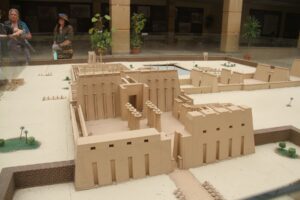
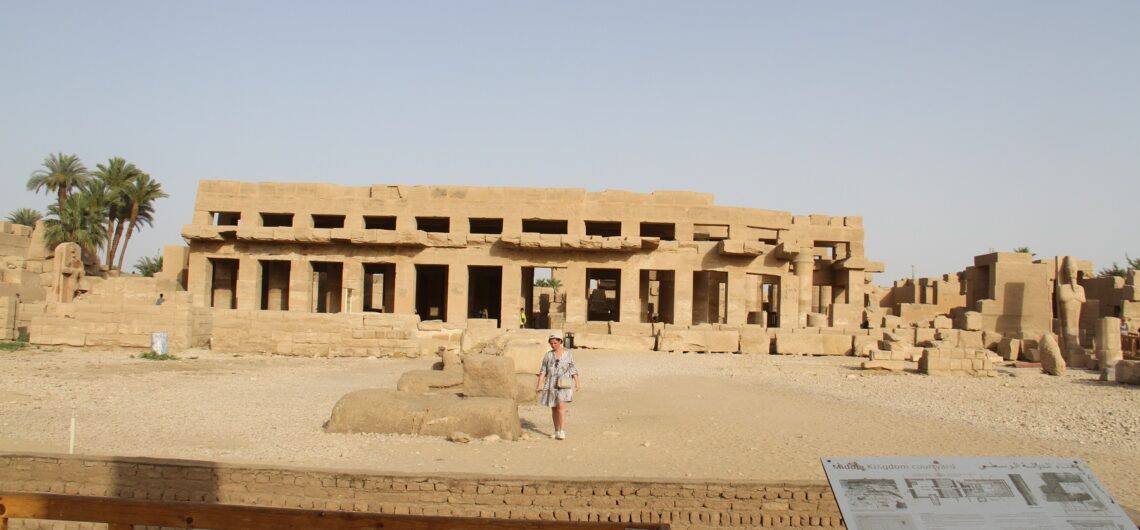
Karnak temple Complex
The Karnak temple complex is located on the east bank of the Nile River at Thebes, North of Luxor.
The temple is considered one of the greatest cult temples, dedicated to the triad of Thebes Amun, Mut and Khonsu. It was used to celebrate ancient Egyptian festivals especially Opet Festivals.
In fact, the temple comprises a vast mix of temples, pylons, chapels, and other buildings. Constructing the temple began during the reign of Senusret I 1971-1925 BCE in the Middle Kingdom till the Ptolemaic Kingdom 305-30 BCE. But most of its building now dates back to the New Kingdom 1550-1080 BCE.
The importance of the Karnak temples
The Karnak temple complex is very important record for ancient Egyptian history and civilization since the Middle Kingdom until the Greco Roman Period. Actually, each ruler was very careful to have his own addition to Karnak temple such as Chapel, Pylon, Obelisk to commemorate his name. but, the Kings of the New Kingdom and onwards insisted to have their own buildings at temple of the supreme god Amun.
The Names of Karnak
The temple was known by various names through ancient times such as
Pr Imn, Means the house of Amun and seems it was the name of the temple even before Senusert as it was found on a stele date back to Intef the second from the 1thdynasty
Niswt Tawy, means the throne of the two lands symbolizing the unity of Upper and Lower Egypt
Ipt Swt, means the most selected of places and it was known from Senusert the first because it was written on the walls of his white chapel at Karnak open air Museum.
Pr Hr Sa Ta which means the sky above earth dates back to the Ptolemaic period
But the word Karnak may be is derived from the Arabic word Khurnaq means a fortified village.
History of the temple
Thebes started to gain importance since the 11th dynasty and the early temples were dedicated to goddess Mut and god Montu but they were destroyed by invaders. Till now, the oldest artifact in the temple area dates back to the 11th dynasty and mentioned Amun Ra as the local deity of Thebes associated with the Ram and the Goose.
Thebes became the capital of the unified Egypt during the 18th dynasty and that led to a significant construction at Amun Ra temple. Each King or Queen added parts to the temple starting with Thutmose the first who erected the oldest surviving part in the temple now.
Hatshepsut restored the temple of Mut and erected two Obelisks, one of them still standing today. She commissioned Karnak Red Chapel as Barque shrine and she ordered to cut another one known as the unfinished Obelisk in Aswan quarries offering insight into the ancient Obelisk quarrying techniques.
Seti first and Ramesses the second began the Great Hypostyle Hall during the 19th dynasty.
Merenptah from the 19th dynasty also commemorate victories over the Sea People of the walls of the Cachette Cort.
Moreover, Nectanebo the first from the 30th dynasty constructed the first Pylon and massive enclosure walls surrounding the temple.
Finally, churches were built inside the temple after roman emperor Constantine the great embrace Christianity and closed all the Pagan temples across the roman empire. For example, the Festival Hall of Thutmose the third served as a church.
Overview
Karnak temple complex is a vast open site and it is considered the biggest all over the world. It consists of four main parts of which only one is open for public. Whenever we mention Karnak is often understood as the precinct of Amun Ra.
2nd part is the Precinct of Mut
3rd part is the Precinct of Mut
4th part is the dismantled temple of Akhenaten
Plus, some more temples and sanctuaries connecting to the precinct of Mut like Luxor temple and the Precinct of Amun-Ra.
In conclusion, the difference between Karnak and other temples and sites is the length of time over which it was devolved and used. Karnak temple started in the Middle Kingdom and continued till the Ptolemaic Era. Also, more than 30 kings added parts to the temple complex.
Main Parts of Karnak
Karnak temple complex occupies 250000m and the main temple of Amun-Ra covers 61 acres. Actually, some parts of the complex are closed including some parts of the Noth South axe. In fact, Karnak can be divided into four areas
1st: to the north, a large enclosure is home to the temple of God Montu and another one to goddess Maat.
2nd: to the east, Amenhotep the fourth or Akhenaten built a huge open-air temple dedicated to god Aten
3rd; to the south another enclosure wall surrounded the temple of goddess Mut and smaller temple for Amenhotep the third
4th: the fourth is the largest and most important called the central enclosure dedicated to Amun Ra and open for tourists. This area is surrounded by enclosure wall built by Nectanebo first of the 30th dynasty measures 21m high and 12m thick.
East West Axe
It is called also the sun axe and it has 6 temples from east to west and it entered via Quay.
The Port, Quay or Jetty
The port of Amun temple is the landing stage connecting the temple to the Nile by means of Canal.
T-shaped sandstone platform
measures 13*15m and it was built to allow the Amun boat to dock and is decorated with two Obelisks of Seti the second.
Avenue of Sphinxes
It was called the way of offerings leading to the first Pylon. The statues are bodies of lions and the head of Ram with small figure of Ramesses the second under the head of the Ram as a sign of protection.
First Pylon
It is unfished and it measures 113m wide, 40m high, and 15m thickness. It was planned by Sheshonk the first but began under Nectanebo the first. There are 4 niches to hold the flagpoles of the temple. The pylon supposes to have a wooden door covered with sheets of gold and bronze with relief decorations.
The first court
It is an open area measures 100m wide and 82m long contains many buildings. some of them remain
- Three Barque shrine of king Seti second
- The temple of Ramesses the third
- Kiosk of Taharqa
- Bubastis Portal
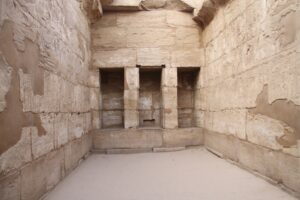
The second Pylon
This pylon started during the reign of Horemheb and was not completed until Seti first. The core of the second Pylon was filled with many sandstone Talatat blocks from Akhenaten temple. Also, the pylon was decorated with two colossi of Ramesses second of which the feet of one remain but there is another huge one with a small figure of Bent anta between his feet.
The Great Hypostyle Hall
The great Hypostyle Hall is consisting of 134 columns divided as following
12 central columns raised by Amenhotep the third standing some 21m high with open papyrus capitals.
66 columns to the left side raised by Seti first standing some 15m high with closed papyrus capitals.
66 columns to the left side raised by Ramesses the second and standing for 15m high
The scenes varied between sunk reliefs and high reliefs describing the military exploits of Seti and Ramesses.
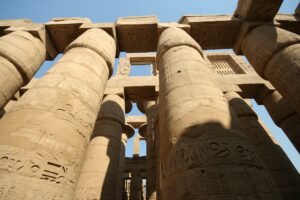
Third Pylon
King Amenhotep the third constructed this pylon but unfortunately its in ruins now. Actually, the king fills the towers of the Pylon with many blocks from earlier building. In the early 20th century, Egyptologists succeeded to reconstruct several monuments especially the white chapel of Senusert and the Red Chapel of Hatshepsut.
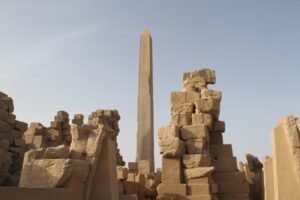
Obelisks of Thutmose and Hatshepsut
Originally there were 6 Obelisks between the third and the fourth Pylon of which only two still remain.
One for Thutmose the first made of red granite almost 22m high and 140 tons weighs. The second is the biggest standing in Egypt for Hatshepsut and its 30m in height and 320 tons.
Fourth and Fifth Pylon
Both were built by Thutmose the first, repaired by Thutmose the fourth and Seti second. Also, Thutmose the third bult a traverse hall behind it. Unfortunately, little remain from the fifth Pylon but it was also the work of Thutmose first.
Sixth Pylon
It was built by Thutmose the third and it leads into a Hall of records in which the king recorded the names of 120 Syrian and Nubian towns he conquered. Behind the pylon, we can see two huge pillars one carved with Lotus and the other with Papyrus. Meanwhile, two statutes for Amun and Mut in the human figure date back to Tutankhamun.
Sanctuary of Philip Arrhidaeus
He was the half brother of Alexander the great and ruled Egypt between 323-317 BCE. He replaced the old sanctuary of Thutmose the third with a new one.
Middle Kingdom structure
It is to the east of the Sanctuary and to the west of the festival hall of Thutmose the third. Its is in very bad condition of preservation.
Festival Hall of Thutmose the third
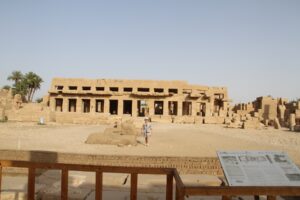
It is called Akhmenu means the most glorious of monuments. Thutmose the third built it to celebrate the Jubilee or the Heb Sed festival and later became part of the annual Opet festival.
The Botanical Garden
It is the first Zoo in the whole world as Thutmose the third in year 25 of his reign, collects all animals, plants, birds during his military campaign and decorated the walls of that room with all of them.
North South Axe
Cachette court
Over 900 statues were found buried under this open court discovered in 1903
Seventh Pylon was built by Thutmose the third
Eighth Pylon constructed by Hatshepsut
Ninth Pylon was built by Horemheb
Tenth Pylon again Horemheb
Sacred Lake
was the place where priests purified themselves before performing the rituals.
Temple of Ptah
To the north of the main temple and it was constructed by Thutmose the third on the site of an earlier Middle Kingdom temple
Temple of Khonsu
Was built by Ramesses the third and its perfect example for a new kingdom temple.
Temple of Opet
West of Khonsu temple and it was built by Nectanebo first, modified by Ptolemy third and was dedicated to the Opet Goddess.