

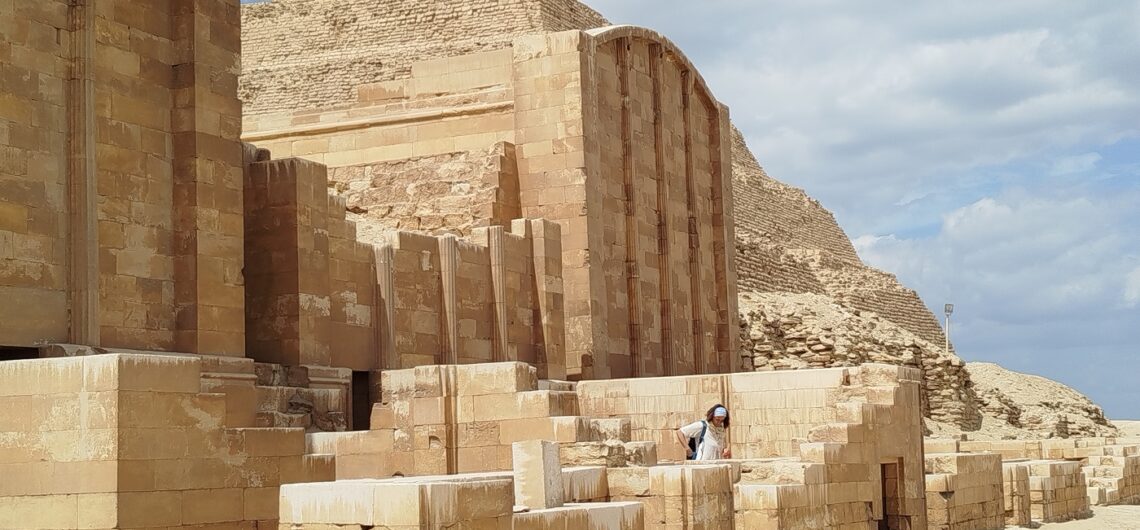
Saqqara Step Pyramid Complex of Djoser
This funerary complex was built by King Zoser; he is a famous king of the 3rd dynasty, other than his other tomb in Beit Khalaf (Abydos). His vizier Imhotep designed and built the complex for King Zoser. The complex of Saqqara is the oldest building that was built of stone.
The Site of Saqqara
The site of Saqqara was selected by Imhotep, which over looking to Memphis. Saqqara was named after the god Sokar, the god of the cemetery. Saqqara was the ancient necropolis of Memphis, the capital of the Old Kingdom.
Saqqara lies to the west of Memphis. It is 7 km long. It extended from Abu Rawash in the north to Meidum in the south. It was divided into many necropolises, such as Giza north, Giza south, Abu Sir, Abu Ghurab, etc. Probably the name Saqqara is derived from the name of Sokar, who was the god of the cemetery.
It is divided into two sections: north and south. The cemetery of Saqqara had been used since the Archaic Period, when the kings of the first dynasty erected their tombs there.
Imhotep,
his name means the man who is coming. Imhotep was not only the vizier of King Zoser, but he was also his chief architect. He was deified in the 26 dynasty.
In the Greco-Roman period, he was associated with God Asclepios, God of Medicine; as a result, he became worshipped as the god of medicine and healing. He was also an astronomer.
Like his predecessors, he had two tombs; the first one is a memorial mastaba at Beit Khallaf, south of Gerga, and the second one is the Step Pyramid at Saqqara.
His name was found inscribed on a famous stela known as the “famine stela,” which dates back to the Ptolemaic Period. This stela was found on the island of Sehel, south of Aswan.
The stela mentions that there was a great famine during the reign of King Zoser because the River Nile failed to rise for seven years.
So Zoser (Djoser) asked for the advice from Imhotep, who said that King Zoser should gain the favor of Khnum god of the first cataract.
Therefore, Zoser went to the first cataract and presented offerings and gifts to the temple of Khnum. As a result, the Nile raised and Egypt was saved.
1-The enclosure wall
The enclosure wall surrounds the complex, with the inner-section wall built of local limestone and the outer wall built of Turah limestone. It takes the shape of recessed paneling.
Its length is about one mile, while the height is 10.4 meters, and it measures 545 meters from north to south and 277 meters from east to west.
There are 14 doorways. 13 of them are unreal (false) to mislead the tomb robbers. Some scholars suggest that the design of the enclosure wall is the design of the royal palace, which is uncertain since we do not have the real design of the royal palace, while others thought that it was the design of the city (inb hd), Memphis, the city of the white enclosure.
2-The entrance
The only real entrance is situated in the southeast corner; there are two tower entrances of the door leads to a passage which ends with the colonnade. The roof of the entrance is represented as palm logs, arranged one beside the other
3-The Colonnades
This passage leads to the colonnades that contain 20 engaged ribbed columns on each of its sides. The space between each column is called an alcove. These 40 columns supported the original roof, which does not exist anymore.
The existing roof is a part of the restoration, and the original roof mostly had the same representation of the roof of the entrance.
There is a suggestion that the original roof was represented as palm logs. These alcoves were used to house the statues of the king wearing either the red or the white crown and represented with one of the local deities of the 40 provinces. But there was nothing found to support such a theory.
4-The transeverse Hall
The colonnade leads to the transverse hall, which contains 8 engaged columns arranged in pairs. The roof of this hall was also decorated with wooden palm-logs (the same as the entrance). The exact function of this hall is not clear, and it leads to the open court.
5-Store rooms
They are situated between the colonnade and the (HEB SED) court, and they are in a load condition. They were used for storing the equipment and the tools needed for performing the funerary rituals.
6-The Southern tomb
It is rectangular in shape, with the longer side from east to west, made out of solid blocks of limestone (slabs of limestone) or masonry of limestone. It consists of a very deep burial shaft; at its bottom, there is the burial chamber, which is entirely made of red granite.
The entrance is through a hole in the roof, which is made of limestone. The size of this granite burial chamber is too small to contain a human body in a normal position.
We consider the southern tomb is the symbolic tomb, which to the people of the south.
There are four theories about this tomb:
1-This was the real tomb of the king.
2-This was the real queen’s tomb.
3-It was the symbolic tomb of the South people.
4-It was for the canopic chest or jars, but we cannot accept it, because normally they were placed next to the mummy of the king.
There are 4 galleries situated to the east of the burial chamber, and they are parallel to each other. They are not finished, but some of their walls are covered with blue tiles and occasionally arranged with limestone panels, these panels decorated with scenes of the king while performing some religious rituals. They also contain the names and titles of the king (Zoser).
7-Building decorated with a frieze of Copras
It is situated almost to the north of the southern mastaba. This building was decorated with a frieze of cobras. The facade of this building is decorated in recessed paneling (like the enclosure wall). The upper part of the wall or the façade is decorated with the frieze of cobras.
Due to its location, some scholars believed that this building served as a funerary chapel for the southern tomb. Others believed that it is connected with some of the rituals of Heb Sed.
8-The Open Court
It is one of the main elements of the Saqqara complex. (4d shaped – offering table – step pyramid – Southern tomb- building with frieze of Cobra).
The HB – SD festival
It is a festival to be celebrated every 30 years by the King to prove his strong enough to rule the country for another period, i.e., to renew his rule to Egypt. Later, it became symbolic, and sometimes it was celebrated after 4 or 5 years.
The major deities of Upper and Lower Egypt, as well as their high priests, would come to the capital of Memphis. As well, 20 of the Great personalities of Upper and Lower Egypt would be invited
The holy Act starts with a procession of the deities and their standards, accompanied by their high priests and followed by the high officials, the members of the royal family, and the fan bearers. The procession will visit the shrines of the deities, give offerings, and burn incense afterward.
The king would be seated on his throne, and crowned once with the red crown, then the white crown, and finally with the double crown. The king would run around the 4D- shaped, his ritual run, holding a roll of papyrus, named the will of the father or the secret of the 2 partners. All to show that the king was powerful enough to rule again.
9-4D OR 2B- Shabed
They are placed in the middle of the open court. They built out of limestone. Some scholars suggested that these (4D shaped) represent the 4 corners of the ancient world, as the ancient Egyptians imagined. Other scholars suggested they were (2B Shaped) constructions, and they were connected with some rituals of the Hb-Sd.
10-The Offerings table
It is situated opposite the southern side of the step pyramid in the open court, it was made out of limestone, and it took the shape of the (HTP) sign.
11-PAVILLION (T-shaped temple)
It is situated behind the Hb-Sd court. This building was probably built for the king to rest in between the different episodes of the festival. Also, it might have been a place where the king changes his clothes while performing the various steps of the Hb-Sd.
It consists of a medium-sized building in a court. The entrance of this pavilion was situated in the middle of the southern side. The facade of the building was built with a slight batter.
The entrance leads to another entrance hall projecting from the western wall to the entrance walls 3 tongue walls 2 of these walls end with ribbed engaged column, and the alcoves in between may have contained statues. The entrance hall leads to 3 inner courts, one behind the other. These courts are surrounded by side rooms.
12-HB-SD Court
It is rectangular in shape; it contains 27 symbolic chapels. – (13 to the west & 14 to the East)- Each chapel is a solid building with a curved roof, with a small open court in front of it, and surrounded by a small enclosure wall. In the
face of each chapel, there is a recess that serves as a small sanctuary to house the statue of the god. The Symbolic chapel was a representation of the original one that used to house the statues of the gods.
This Hb-Sd court was constructed as a model or a copy of the original one, which the king used in Memphis during his life time, to keep up the remembrance of the King. To the south east, three limestone statues were found 3 limestone statues the first statue for a god (PTAH), the second one for King Zoser in his Osiride position, and the last one its features are damaged and unidentified.
In the north west of this court, there are 4 pairs of feet, the remains of the statues, perhaps representing the king, his wife and his 2 daughters. This court provides representation of the original court where King Zoser has performed his rituals (Hb-Sd)
The Coronation Platform:
They used to place a tent on it. This tent is used for crowning the king once with the white crown, once with the red crown and
finally with the double crown during the different steps of the festival.
13-House of North and South
These 2 buildings are situated to the east of the pyramid. They are quite identical in shape and size. Each building was built of solid masonry covered with dressed limestone. The facade of each building is decorated with 4 fluted columns then plastered. At each house there are 3 niches for the crown, symbol, and flower.
- In the middle of the southern face is the entrance that leads to a narrow passage with two right-angle turns.
- The end of the passage is a cruciform sanctuary which has two recesses.
- The roof of the passage has the decoration of wooden rafters.
- In front of the house is a court surrounded by an enclosure wall. The east side wall has three engaged papyri columns.
B- House of the South
- -The facade has four fluted pendant leaves.
- It has the same design as the house of the north.
- By the enclosure wall. The east wall has a broad recess that contains one engaged column.
14 – The Serdab
It is a small, enclosed chamber situated a short distance to the east of the entrance of the Mortuary Temple, in other words, to the north east side of the Step Pyramid. It is built entirely from fine Tura limestone.
It is attached to the lowest step of the Step Pyramid. The front and back walls are inclined by an angle of inclination (16°) similar to that of the lowest step of the pyramid.
It has no doors except for two holes in the front wall opposite to the face of the statue of Zoser found inside.
There are 3 theories about the presence of these holes:
- Either to enable the king’s statue to smell the incense.
- Or to observe the funerary rituals performed outside.
- Or to face the never-setting circumpolar stars (the North Star).
The statue was made out of limestone, representing the king seated on a low-backed throne wearing the Heb Sed garment. The original one is kept in the Egyptian Museum, while the one in Saqqara is a replica.
The Serdab is surrounded by a small enclosure wall with two entrances, one in the South and the main one in the North side, with an imitation of an open door.
The Serdab was called pr twt or house of the statue.
15 -The Morutary temple
It is a building situated to the north of the Step Pyramid. It is rectangular in shape and it is attached to the lowest step of the pyramid.
The entrance is situated in the eastern side, and it is decorated with an imitation of an open door. It leads to a passage with numerous turns leading to two open courts.
Each court has a room with a water basin for purification in the western side. In the second court, there is a staircase, which leads to the original entrance of the Step Pyramid.
At the southern end of each court, there are three gangways, each is made of a tongue wall terminating in two engaged fluted columns. All the gangways lead to a wide gallery.
At the southern end of the gallery, there is the sanctuary, which consists of two recesses sunk in the lowest step of the pyramid.
N.B. This mortuary temple is situated to the NORTH of the pyramid, while a later mortuary to the EAST of the pyramids
It is found to the north of the complex, between the northern side of the enclosure wall and the mortuary temple. It is made out of limestone, but it’s unfinished. This platform was perhaps intended to be used for slaughtering.
17- Two Rows of Tombs
There are 2 rows of tombs for high officials and relatives of the king to the western side of the complex. The outer row is higher than the inner row. Each row has a curved roof the 2 rows are now in ruins.
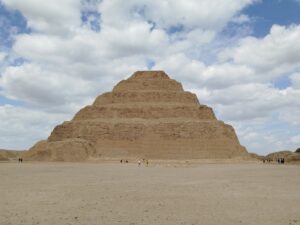
18-The Step Pyramid
- It is built of local limestone and covered or dressed with Tura limestone.
- It consists of six steps and its present height is 204 ft.
- Its ground plan is not square, but it is of irregular shape.
- The original entrance of the pyramid is situated at the northern side, while the present entrance is situated to the south, dating back to the 26th dynasty.
A- The Development of the Super Structure
The building of the Step Pyramid underwent several stages until it reached its final form as a massive structure rising in 6 unequal steps to a total height of 60 m. Its base measures about 140m from east to west and about 118 m from north to south.
Stage no 1:
The original mastaba had a square plan with each side measuring 63m long and
about 8 high. The core was built of solid local limestone but was cased with a layer of fine Tura limestone.
Stage no 2:
The first addition was an extension of 3 m on all sides, but a little bit lower in height.
Stage no 3:
The second addition, which was 9 m on the eastern side, made the tomb rectangular in shape with the longer axis running from east to west.
Stage no 4:
The third addition was another 3m to all sides. At this point, the altered mastaba became the lowest step consisting of 4 mastabas erected one above the other, forming a 4-stepped pyramid.
This was intended to be the final stage thus a mortuary temple was begun on the northern side.
Stage no 5:
But due to another change of plan, the pyramid was extended towards the north and the west.
Stage no 6:
The sixth and the last extension to the pyramid added a little on each side and the six steps were completed.
In the end, the six-stepped pyramid was cased with a final layer of fine Tura limestone.
B- The Development of the Sub-Structure:
At first, it consisted of a shaft whose mouth is square, measuring 7 m each side, its depth was 8.5 m. At a depth of 7 m from the top a tunnel was dug to the north its length was 20 m, then it was extended for another 21 m and ended in an open trench (because of the completion of the 3rd extension of the superstructure).
The bottom of the shaft was then lowered until it reached a total depth of 28m, where they built the burial chamber for the king. It was built entirely of pink granite, measuring 2.96 m X 1.65 m and 1.65 m high. It doesn’t have any doors; the only entrance is a hole through which they could lower the body of the king.
They built another room on top of the burial chamber. It was made of limestone and had a corbelled roof. Nothing remains of it now, and it used to serve for two things:
- To temporarily store the plug of the burial chamber, which weighed 3 tons.
- The roof was corbelled in order to store stones and rubble over it to fill the space around the king’s chamber.
B.I. The Four Galleries
At a distance of 21m from each side of the burial chamber, there was a gallery made (4 galleries). They weren’t connected except with small side passages.
These galleries can be reached through two small rooms at the end of the tunnel (to the east and the west). All these galleries are unfinished except for the eastern one which is partly completed.
Parts of the wall of these galleries are covered with blue tiles imitating the wall at the king’s palace or to provide the necessary atmosphere related to the underworld.
Also, they are panels containing reliefs representing the king performing religious rituals most probably the Heb Sed ritual. Above the panels there were hieroglyphic inscriptions giving the titles and names of the king (ntr bt Nether-Khet: the divine body).
B.I. The Eleven Burial Shafts
There are 11 burial shafts to the north east of the pyramid, each runs to a depth of 32 m, and then it is directed 30 m towards the west under the original mastaba and ends in a court containing a limestone pedestal for a coffin.
The only one shaft outside of the superstructure of the pyramid is the 11th one because the rest were covered due to the 3rd extension of the Step Pyramid. The 11th one contains the only entrance to the rest. Few elements were found in these shafts, like for example a coffin containing
the remains of a child about 8 or 10 years old, and some alabaster vases, either dating back to King Zoser’s reign or to the First and Second dynasties. These shafts were believed to be used for burying the close family of the king.