

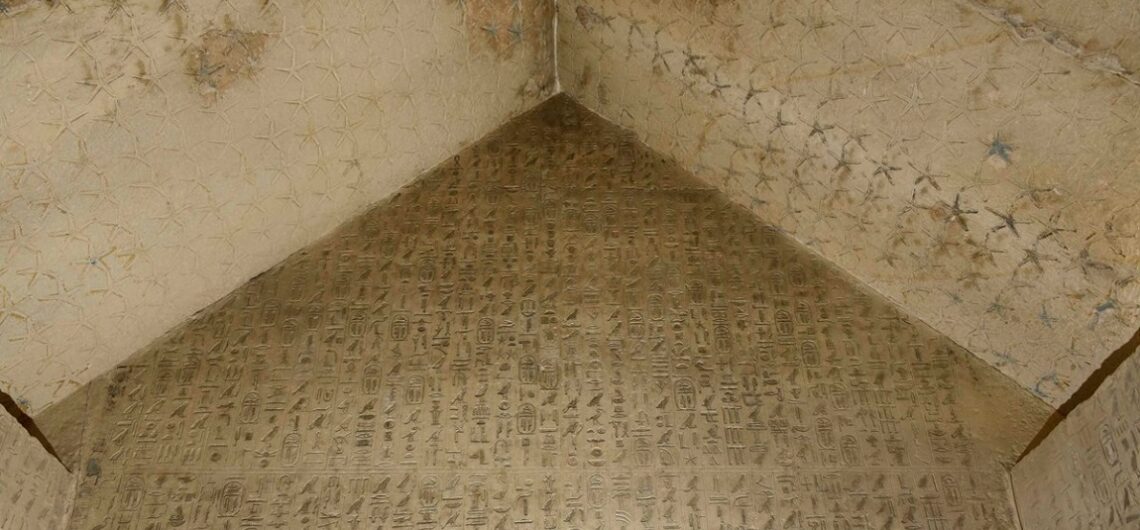
Ancient Egyptian Pyramid Texts
The Pyramid Texts represent the oldest corpus of ancient Egyptian religious texts ever discovered. Carved into the subterranean walls of the Saqqara pyramids, these sacred hieroglyphs offer an unparalleled window into the Old Kingdom’s beliefs regarding death, divinity, and the eternal soul.
What Are the Pyramid Texts?
The Pyramid Texts are a sophisticated collection of ancient Egyptian spells, hymns, and liturgical instructions.
Unlike later funerary traditions, these were inscribed exclusively on the walls of royal pyramid complexes.
They served as a “cheat sheet” for the soul, containing the secret knowledge required for the deceased king to transcend his earthly form and join the gods in the afterlife.
The Purpose and Significance of the Pyramid Texts
In the complex landscape of ancient Egyptian religion, the king was the bridge between humanity and the divine. The purpose of the Pyramid Texts was to ensure this bridge remained intact after death.
Divine Ascension:
The texts functioned as a magical catalyst, helping the pharaoh transform into an Akh (an effective spirit) to navigate the celestial realms.
Protection and Power:
They provided specific spells and incantations to protect the king from underworld predators and spiritual obstacles.
Royal Authority:
By declaring the pharaoh, the “son of the sun god,” the texts solidified his right to rule over the gods in the afterlife.
Funerary Rituals:
They acted as a permanent record of essential ceremonies, such as the Opening of the Mouth, which restored the king’s ability to eat, speak, and breathe for eternity.
Who Wrote the Pyramid Texts?
While no single author is credited, the Pyramid Texts were the intellectual work of the high priests of Heliopolis. These elite scribes and theologians compiled centuries of oral traditions and myths into a written format.
Because the texts evolved over generations, they reflect a collective voice, showing continuous revision and expansion from the 5th Dynasty through the 6th Dynasty.
When Were the Pyramid Texts Written?
These inscriptions date back to the Old Kingdom of Egypt, specifically between 2400 BCE and 2150 BCE. This era, often called the “Age of the Pyramids,” was a time of immense architectural and religious innovation.
Which Pyramids Contain the Pyramid Texts?
It is a common myth that all pyramids contain writing. In reality, the famous Great Pyramids of Giza are silent. The Pyramid Texts are found only in specific complexes located in the Saqqara necropolis:
- Pyramid of Unas: The earliest and most complete version.
- Pyramid of Teti: The first of the 6th Dynasty to feature these spells.
- Pyramid of Pepi I: Noted for its extensive wall coverage.
- Pyramid of Merenre: A continuation of the 6th Dynasty tradition.
- Pyramid of Pepi II: The final great royal collection of the Old Kingdom.
The Oldest Known Version: The Pyramid of Unas
The oldest known version of these texts belongs to King Unas (c. 2375–2345 BCE). Located at Saqqara, the burial chamber of Unas is world-renowned for its vibrant, turquoise-filled hieroglyphs that remain remarkably preserved today.
How Were the Pyramid Texts Created?
The production of these texts was a monumental task involving specialized scribes and master carvers.
Hieroglyphic Writing: Each symbol was planned to represent phonetic sounds or complex concepts.
Sunk Relief Technique: Scribes often used a technique where the hieroglyphs were carved into the stone and then painted, usually in blue or green to symbolize rebirth and the sky.
Exclusivity: These were not meant for the public eye. They were “hidden” within the burial chambers, intended only for the king and the gods.
Pyramid Texts vs. Coffin Texts: What’s the Difference?
While both focus on the journey to the afterlife, they represent different eras of Egyptian culture:
| Feature | Pyramid Texts | Coffin Texts |
| Era | Old Kingdom | Middle Kingdom |
| Location | Pyramid Walls | Wooden Coffins |
| Audience | Royalty Only | Non-royal Elites |
| Evolution | The Original Source | A “Democratized” Continuation |