

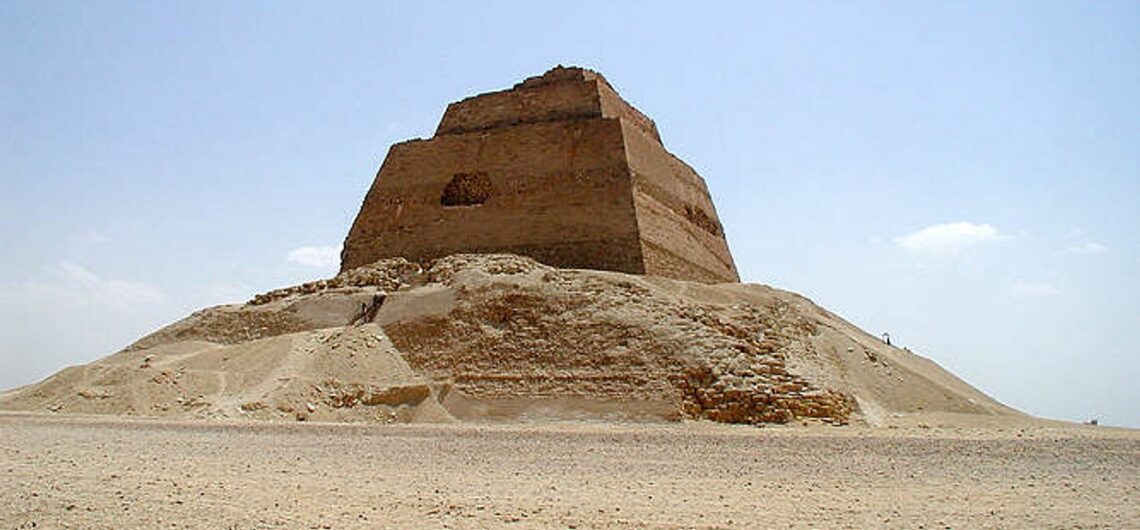
The Pyramid of Meidum: Egypt’s first “True” Masterpiece
The Pyramid of Meidum represents a defining moment in the architectural evolution of ancient Egypt.
Location
Located on the desert’s edge near Beni Suef, this massive structure is often called the “False Pyramid” (el-haram el-kaddab).
It isn’t just a tomb; it is a frozen snapshot of ancient Egyptian trial and error—the exact moment when architects stopped building steps and started reaching for the smooth, slanted perfection of the heavens.
Through its design and construction, the pyramid reflects both the ambition and the growing technical expertise of ancient Egyptian builders, making it a key example in the study of pyramid development.
The Architect’s Laboratory: From Huni to Sneferu
Most historians agree that the project began under Pharaoh Huni (the last king of the 3rd Dynasty) as a traditional step pyramid. However, it was his successor, the legendary Pharaoh Sneferu, who turned Meidum into a radical experiment.
Sneferu didn’t just want a bigger monument; he wanted a different one. He ordered his builders to “fill in” the steps with high-quality Tura limestone, creating the first-ever true smooth-sided pyramid. This transition is the most significant pivot in the history of Ancient Egyptian architecture.
Why Does It Look Like a Tower?
Visitors today are often struck by Meidum’s bizarre appearance. It looks less like a pyramid and more like a three-tiered fortress rising from a mountain of debris. For decades, the “Catastrophe Theory” suggested the pyramid collapsed during construction.
Modern research, however, paints a different picture. The “collapse” was likely a slow-motion event caused by:
- Foundational Shifts: Unlike the Giza pyramids, which sit on solid bedrock, Meidum’s outer casing was built on a layer of sand and rubble.
- Quarrying: Over millennia, local builders “recycled” the smooth limestone casing for other projects, eventually exposing the internal core we see today.
Meidum emerged as one of the earliest organized royal necropolises following the archaic period, signaling a shift toward more complex and planned burial landscapes.
Scholars continue to examine the question of its ownership. Although some early interpretations attributed the pyramid to King Huni, archaeological findings—including inscriptions and graffiti within the complex—consistently refer to King Sneferu.
The repeated appearance of the name “Djed Sneferu” in ancient sources further strengthens this attribution.
The present structure of the pyramid gives it a distinctive and somewhat unusual appearance, as it resembles a massive three-tiered tower rising above the desert landscape.
This form clearly reflects a transitional stage between the traditional step pyramid and the true pyramid.
Builders adopted earlier design concepts from Saqqara and applied similar construction techniques during the initial phases, while also introducing modifications that demonstrate architectural experimentation.
Meidum Pyramid
Originally, the pyramid reached a height of approximately 92 meters and rested on a carefully prepared base. Builders began with a mastaba core and gradually expanded the structure by adding multiple layers of masonry, forming a stepped configuration.
They later filled these steps and applied a smooth outer casing, successfully transforming the structure into a true pyramid. This process highlights a significant phase of innovation and experimentation in construction methods.
The entrance appears on the northern face of the pyramid, positioned about 30 meters above ground level.
A descending passage, measuring around 57 meters in length, leads into the bedrock beneath the structure. This passage connects to internal chambers and ultimately to a vertical shaft that rises to the burial chamber.
Builders lined the burial chamber with limestone and constructed its roof using a corbelled technique, creating a stepped internal form that enhances structural stability.
Meidum Pyramid Complex
On the southern side of the pyramid, builders constructed a smaller satellite pyramid, which likely held symbolic or ritual significance within the overall complex.
To the east, they built a mortuary temple enclosed by a perimeter wall. The layout of this temple remains relatively simple yet functionally effective.
The entrance leads into a passage, which connects to a chamber and then opens into an uncovered court.
At the center of this court, priests carried out daily offering rituals using a dedicated offering table. Two limestone stelae stood on either side, reinforcing the funerary purpose of the space.
The pyramid complex also includes an enclosure wall and a causeway that extends toward the edge of the cultivated land.
At the end of this causeway, a valley temple once stood. However, rising groundwater caused its destruction, preventing further archaeological investigation in that area.
The Mystery of the Missing King:
No sarcophagus was ever found here. Meidum remains a “Cenotaph”—a symbolic empty tomb—proving that for Sneferu, building was as much about political branding as it was about the afterlife.
Conclusion
The Pyramid of Meidum stands as a powerful representation of innovation in ancient Egyptian architecture.
It demonstrates the determination of builders to refine structural techniques and achieve the ideal pyramid form.
Despite its current condition, the monument continues to provide valuable insight into the phase of architectural development and remains a fundamental reference for understanding the evolution of pyramid construction in ancient Egypt.