

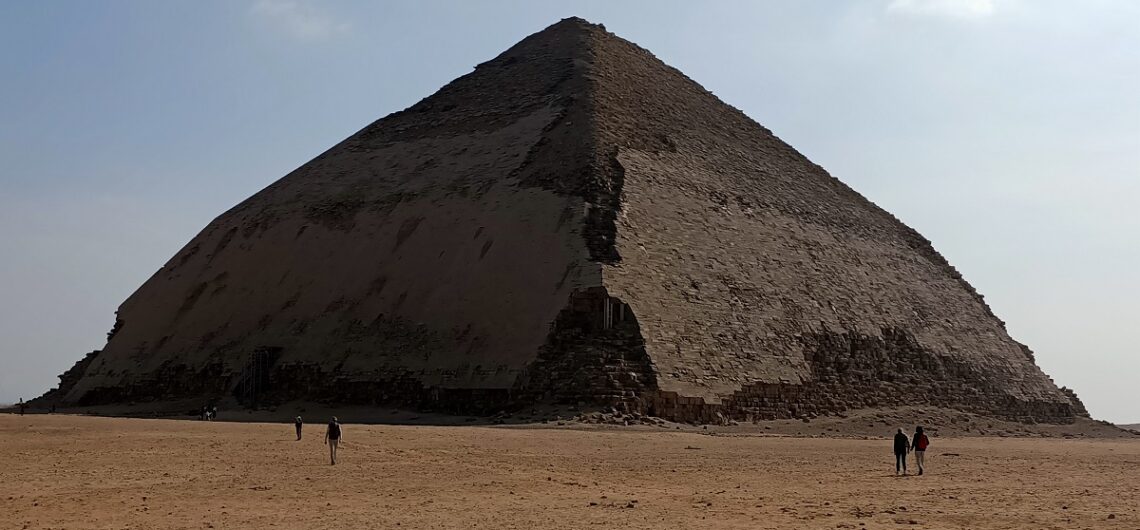
Dahshur Pyramids (“Cradle of Innovation.”)
The Hidden Meaning of Dahshur: A Landscape of Innovation
To truly understand the pyramids of Dahshur, one must look past the stone and into the etymology of the name itself. Dahshur is not merely a geographic location; it is a testament to the fertility of the human mind according to some.
The Etymology of Dahshur: A Source of Ideas
The name Dahshur is derived from two profound roots:
“Tah”: Meaning “Well” or “Source of.”
“Soor”: Meaning “Fertility.”
While many associate fertilities with the physical land or biology, in the context of Dahshur, it refers to a fertility of ideas. This site was the ultimate “think tank” of the Old Kingdom.
It was the source from which the transition from “Step Pyramids” to “True Pyramids” sprang. It represents the intellectual abundance required to solve the greatest engineering puzzles of the ancient world.
Sneferu: The Architect of Beauty
The builder of this sacred site, Pharaoh Sneferu, carries a name that perfectly mirrors the mission of Dahshur. His name is a linguistic masterpiece:
“Nefer”: The root for beauty, goodness, or perfection.
“S”: The causative prefix, meaning “the one who causes” or “the bringer of.”
Therefore, Sneferu translates to “The One Who Causes Beauty.” He was not just a king; he was a visionary strategist who transformed the rugged Egyptian landscape into a canvas of architectural perfection.
At Dahshur, he “caused beauty” by refining the pyramid’s shape, leading to the creation of the Red Pyramid—the world’s first successful smooth-sided pyramid.
Why This Matters for Your Visit
When you stand before the Bent Pyramid or the Red Pyramid, you are standing at the “Well of Fertility.” You are witnessing:
The Birth of Perfection:
How Sneferu’s drive to “cause beauty” led to the golden ratio of pyramid construction.
A Legacy of Thought:
A place where ancient engineers were allowed the “fertility of mind” to experiment, fail, and eventually succeed.
A Spiritual Source:
A site that continues to inspire modern visitors with its quiet, intellectual energy.
The Celestial Alignment of Dahshur: Beyond the Stars
While the Pyramids of Giza are famously aligned with the constellations of the stars like Orion constellations, the masterpieces at Dahshur follow a different cosmic blueprint.
Here, the “Source of Fertility” (Dahshur) connects not with distant stars, but with the planets of our own solar system, creating a unique energetic frequency found nowhere else in Egypt.
The Red Pyramid: The Forge of Mars
The Red Pyramid is not merely named for its crimson hue; it is an architectural mirror of the planet Mars.
The Horus Connection:
Ancient Egyptians called Mars Hr Desher (Horus the Red).
The Iron Signature:
Just as Mars is defined by its high concentration of iron oxide, the Red Pyramid is built from local red limestone rich in iron.
The Energy of Action:
This alignment creates a “Martian” energy—one of strength, vitality, and the “Fertility of Ideas” brought into physical reality. It is the masculine, driving force of Sneferu, “The One Who Causes Beauty.”
The Bent Pyramid: The Lunar Sanctuary
In contrast, the Bent Pyramid is aligned with the Moon.
Reflective Energy:
While the Red Pyramid represents the heat of Mars, the Bent Pyramid embodies the cooling, reflective, and intuitive energy of the Moon.
The Alchemy of Balance:
The unique change in the pyramid’s angle represents a shift in frequency, harmonizing the earth with lunar cycles. It serves as a source of “Tah” (the well), drawing in a more receptive, feminine spiritual energy.
A Different Energetic Signature
The Celestial Blueprint of the Egyptian Pyramids
The pyramid fields of Egypt were not placed at random; they served as a terrestrial mirror for the heavens. Each site vibrates with a specific frequency based on its alignment with distant stars, planetary bodies, or “astral gateways.”
| Sacred Site | Celestial Alignment | Energetic Signature & Purpose |
| Giza Plateau | Orion’s Belt | Represents the soul’s journey into the afterlife and universal resurrection. |
| Abu Sir | The Pleiades (The 7 Sisters) | A site of solar temples focused on cosmic cycles and the “opening of the light.” |
| Saqqara | The Astral Gates | The gateway for the transformation of the soul, bridging the physical and spiritual realms. |
| Dahshur (Red) | Mars (Hr Desher) | Aligned with the iron-oxide planet; represents active creation and the “Fertility of Ideas.” |
| Dahshur (Bent) | The Moon | Aligned with lunar cycles; represents intuition, cooling energy, and spiritual receptivity. |
The Healing Frequencies of Dahshur: DNA Repair and Spiritual Detox
Beyond their architectural brilliance, the pyramids of Dahshur serve as ancient “energy laboratories” designed to harmonize the human body and spirit. While Giza focuses on the cosmos, Dahshur focuses on the regeneration of the self.
The Red Pyramid: Cellular Regeneration & The “DNA of Beauty”
Aligned with Mars (Hr Desher) and built from iron-rich red limestone, the Red Pyramid resonates with the physical body’s foundational building blocks.
DNA Alignment:
The specific frequency within the Red Pyramid is believed to interact with the iron in our blood, helping to repair and realign DNA strands. It acts as a biological “reset,” encouraging the fertility of healthy cells.
Dermatological Vitality:
In harmony with the name of its builder, Sneferu (“The One Who Causes Beauty”), this pyramid’s energy is traditionally linked to skin rejuvenation and cellular health. The iron-oxide resonance supports the body’s natural glow and physical vitality.
The “Action” Energy: It provides the drive needed to turn thoughts into reality, clearing the path for the Fertility of Ideas.
The Bent Pyramid: Lunar Detox & Spiritual Clarity
The Bent Pyramid, aligned with the Moon, operates on the subtle, emotional, and spiritual layers of the human experience.
Expelling Negativity:
Just as the Moon governs the tides, the energy of the Bent Pyramid helps “pull” negative emotional imprints and stagnant energy out of the spiritual body. It is a site for deep spiritual detoxification.
Intuitive Balance:
The unique dual-angle of this structure creates a shift in frequency that calms the nervous system. It is the ideal space for those seeking to balance their inner masculine and feminine energies.
Reflective Growth:
This is the “Well of Fertility” for the soul, providing a quiet space to receive divine guidance and gain clarity on one’s life purpose.
| Pyramid | Celestial Link | Biological/Spiritual Benefit |
| The Red Pyramid | Mars | Physical: DNA repair, skin health, and blood vitality. |
| The Bent Pyramid | The Moon | Spiritual: Clearing negativity, emotional detox, and intuition. |
Dahshour from the historical point of view
The Site of Dahshur
Dahshur is a royal burial area located south of ancient Memphis. It is less crowded than Giza, but it is one of the most important sites for understanding the development of pyramid construction in ancient Egypt.
Dahshur was used as a kind of experimental area where ancient Egyptians tried new architectural ideas. Because of this, it played a very important role in the evolution of pyramid design.
King Sneferu
King Sneferu was the founder of the Fourth Dynasty and one of the greatest builders of ancient Egypt. He ruled during a stable period, which allowed him to focus on large construction projects.
Sneferu is known for his innovation in pyramid building. Instead of building one pyramid, he built several, each one improving on the previous design. His main works are located at Dahshur.
The Funerary Complex of Sneferu
The funerary complex at Dahshur is made up of two main pyramids and several surrounding structures. Together, they form a complete system connected with religion, burial rituals, and royal beliefs about the afterlife.
The Two Pyramids
The Bent Pyramid
Bent Pyramid is one of the most unique pyramids in Egypt. Its shape changes halfway up because the builders adjusted the angle during construction.
This change was likely made to avoid structural problems. Although it looks unusual, it is very important because it shows how ancient engineers learned and corrected their mistakes during construction.
The Red Pyramid
Red Pyramid is located in the northern part of Dahshur. It is considered the first successful true pyramid in Egypt.
It was built with a stable and consistent angle from the beginning. Its reddish color comes from the limestone used in its construction. This pyramid represents the final stage of Sneferu’s architectural development.
Other Elements of the Complex
The Valley Temple
The valley temple was located near the Nile. It was the starting point of the funerary journey, where purification rituals were performed.
The Causeway
The causeway was a long-covered pathway connecting the valley temple to the pyramid. It symbolized the journey from life to the afterlife.
The Mortuary Temple
The mortuary temple was located next to the pyramid. It was used for daily rituals and offerings made by priests to honor the king.
The Satellite Pyramid
A smaller pyramid built near the main pyramid. It had a symbolic or religious role connected to the king’s spirit rather than being a burial place.
Conclusion
The funerary complex of King Sneferu at Dahshur shows an important stage in ancient Egyptian history. It reflects the development of pyramid construction from early experiments to successful design. It also shows how ancient Egyptians improved their engineering step by step.