

Pyramid of Teti, Saqqara
Who was King Teti?
King Teti was the first ruler of the 6th Dynasty, even though he was possibly the son of Unas, the last ruler of the 5th Dynasty.
Pyramid of Teti is called “Teti’s (cult places are enduring”. though this pyramid has not endured very well.
Giza Pyramids Vs Teti Pyramid
While the Great Pyramids of Giza command the horizon with their sheer scale, the Pyramid of Teti in Saqqara offers a more intimate, profound encounter with Egypt’s Old Kingdom.
To the casual observer, the exterior looks like a weathered hill of limestone, but this Sixth Dynasty monument (c. 2345 BC) holds its greatest treasures beneath the surface.
Teti Pyramid Complex
The Pyramid of Teti
The pyramid is built of small blocks of local limestone, and the outer case is covered by fine Tura limestone.
The present height of the pyramid is 20 meters, and is 65 square meters. The entrance is at the ground level of the center of the pyramid to the north side.
A Design for the Afterlife
Architecturally, Teti’s pyramid represents the peak of a specific structural evolution. Though its outer casing of fine white limestone was stripped away by ancient builders, the internal blueprint remains a masterpiece of precision.
The layout follows a calculated ritual path:
The Descending Corridor:
The entrance led to a passage that descends to a vestibule. The vestibule leads to an antechamber. On the northeast side of the pale chamber was a recess. On the west side is the burial chamber that contained a basalt sarcophagus.
Both of these rooms had gabled ceilings made from three layers, and the level of the three layers was slightly above the base of the pyramid.
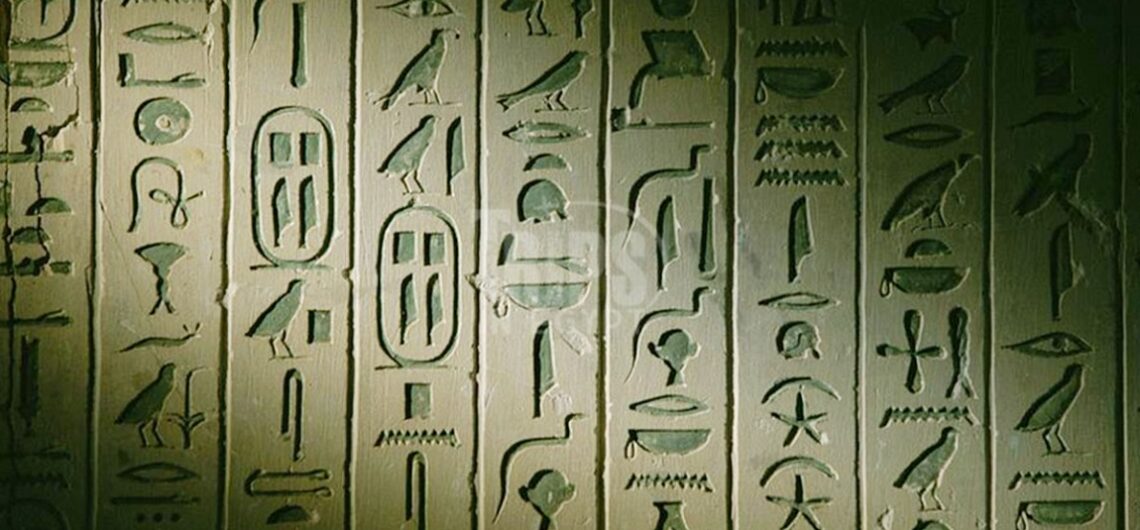
The walls of the burial chamber are covered with limestone. In addition, both the walls of the burial chamber and the antechamber are inscribed with the Pyramid Text. The ceilings have astronomical ceilings (with stars).
The Vaulted Ceiling:
Inside the burial chamber, the ceiling is a celestial map, carved with pointed stars to mimic the night sky, ensuring the Pharaoh never lost his way among the “imperishable ones.”
The Sarcophagus:
A massive, dark basalt sarcophagus still sits within the chamber, a heavy anchor for the king’s physical remains.
The Valley temple
This temple and the three-hundred-meter-long causeway, leading to the mortuary temple, have not been archaeologically excavated.
Both the Valley Temple and the causeway are located not to the east but to the southwest of the pyramid. The Causeway has disappeared entirely except for some parts on the west, and it might have been built of mud bricks
The Mortuary Temple
There are a few remains of the mortuary temple, its entrance passage is flanked by store rooms and annexes.
It leads to a central courtyard with 18 pink granite pillars, all square except those in the corners.
As usual, the king’s name and titles were inscribed in deep relief. In the middle of the courtyard once stood a low stone altar.
Just behind the courtyard is the transverse corridor that divides the outer part of the mortuary temple from the inner sanctums.
The walls of the corridor were originally decorated with scenes showing the king and gods, the Sed festival, and the smiting of Egypt’s enemies. From here, the five-niche chapel is accessed from a low stairway in the middle of the west wall.
Behind the chapel is the offering hall with its false door on the west wall (the wall next to the main pyramid).
The false door’s function was to allow the deceased king entrance into the offering hall for his symbolic meals.
Originally, the offering hall was decorated with scenes of sacrifice, though only fragments remain.
Like the Buter part of the mortuary complex, storage annexes are found on either side of the chapel and the offering table
The Cult Pyramid
The cult pyramid stands on the southeast corner of the main pyramid and has its own enclosure wall, as customary. There is an open courtyard around the main pyramid with its own enclosure wall.
In the northwest part of this courtyard is a forty-meter-deep shaft that was probably used as a well by the original builders of this complex.
The sarcophagus is on the west wall of the burial chamber, along with the funerary equipment, but is now gone.
On the southwest corner of the location where the sarcophagus stood is a small hole in the floor that must have once held a canopic chest.
Though decorated with inscriptions, the sarcophagus was never finished. There were six elementary remains of an alabaster table with an antechamber (left), which is a Serdab with three deep niches.
The Surrounding “City of the Dead”
The Teti complex is unique because it created a “magnetic pull” for the most brilliant minds of the era. Surrounding the King’s pyramid is a dense street of tombs, featuring the mastabas of high-ranking officials like Kagemni and Mereruka.
Visual Artistry: The reliefs in these surrounding tombs are so detailed that they act as a high-definition window into the Old Kingdom’s daily life, from harvest scenes to complex medical procedures.
Royal Family Unity:
The complex also houses the smaller, intimate pyramids of Teti’s wives, Queen Iput and Queen Khuit, ensuring the family unit remained unified in the afterlife.
The Power of the Written Word
The Pyramid of Teti is world-renowned for containing the Pyramid Texts—the oldest sacred scriptures known to man. Unlike the pyramids of the 4th Dynasty, which used sheer scale to reach the gods, Teti used the fertility of the written word.
These inscriptions are not just “spells”; they are a technical manual for the soul. They provided the phonetic vibrations required to unlock the Astral Gates of Saqqara. Standing in this chamber, you are surrounded by a symphony of hieroglyphs that describe: