

Pyramid of Unas in Saqqara: Complete Guide and Mysteries
The Pyramid of Unas, located in the ancient necropolis of Saqqara, is one of the most captivating monuments in ancient Egypt.
Although it is the smallest pyramid built during the Old Kingdom, its historical and spiritual significance is monumental, marking a definitive turning point in funerary architecture and religious literature.
The Builder: Pharaoh Unas
Pharaoh Unas was the final ruler of the Fifth Dynasty. His reign signaled the end of an era of architectural grandeur. Unlike his predecessors, who sought immortality through colossal monuments, Unas shifted the focus toward the magical protection of the soul.
His pyramid, originally named “Beautiful are the places of Unas,” represents a transition where the power of the written word began to complement the power of stone.
The Pyramid of Unas
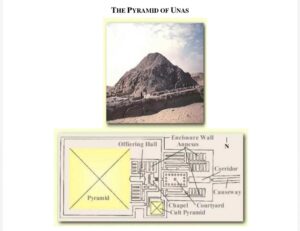
It is 67 square meters and is about 19 meters high, originally 44 meters.
It is located in the southwest corner of the complex of Djoser
The pyramid is in bad condition. It is built of local limestone and dressed with fine Tura limestone.
The entrance is at the ground level in the center of the north face. It leads to a passage that ends in a vestibule
The vestibule leads to an antechamber a short passage leads to three small recesses
On the west of the antechamber, there is another short passage that leads to the burial chamber, which has a pointed roof
The pointed roof is decorated with stars
All the ceilings of the corridors, antechamber, and burial chamber are painted with yellow stars on a blue background. In both of the chambers, the pyramid text was written in bas-relief and painted on a blue-green.
This color signifies the morning and the belief in rebirth.
The west wall of the burial chamber was coated with a layer of alabaster that was painted white, black, yellow, blue, and red, the five colors of the royal palace façade.
Inside the burial chamber is a sarcophagus of black granite.
The Causeway
It is 600 meters long, and it runs between the mortuary temple and the valley temple. It was built of limestone.
The causeway is not straight, making two turns to probably avoid ground or even other buildings
In fact, materials from other buildings were used on the pavement of the causeway
In 1970, the Egyptian archeologists reconstructed the tomb of the two brothers Niankhkhnum and Khnumhotep, which is now a popular tourist destination, mostly from blocks found in Unas’s causeway.
The walls of the causeway are decorated with bas-relief scenes of men hunting for lions, leopards, and giraffes; boats transporting granite palm columns from Aswan; battles with Asians enemies, the transport of prisoners, and of course, the well-known scenes of starving natives.
However, the meaning of this scene of starving natives is less clear today than ever. It was originally believed that the scenes record the decline of this period, but now theories oppose this assumption.
Just south of the upper part of the causeway were two large boat pits of limestone that were once probably held long, slender wooden boats.
The Mortuary Temple
The mortuary temple is in ruined condition, and it is entered through a pink granite gateway inscribed with the names and titles of Unas.
One first enters the alabaster-paved entrance hall; after the entrance hall is the open courtyard. The ambulatory was supported by eighteen pink granite columns shaped as palms; the floors are of alabaster, and the walls are of limestone.
The eighth side of the entrance hall and the courtyard are storage annexes. Large shaft tombs were also dug in the late period
Several entrances lead to the small cult Pyramid and into the inner temple and the five-niche chapel. Though nothing remains of this. Also, the offering hall and annexes were destroyed. Around the offering hall are more storage annexes.
The Valley Temple:
Originally situated on the shores of a now-vanished lake, this was the reception point for the Pharaoh’s body. Its granite columns and alabaster floors welcomed the funeral procession.
Restorations by Khaemwaset: The First Archaeologist
Centuries after the death of Unas, during the 19th Dynasty, the pyramid suffered from the passage of time. It was Prince Khaemwaset, the son of Ramesses II, who took charge of its restoration.
Often regarded as the world’s first archaeologist, Khaemwaset felt a profound reverence for the monuments of his ancestors. He left an inscription on the south face of the pyramid documenting his repair work, ensuring that the name of Unas would not be forgotten by future generations.
Why Visit the Pyramid of Unas?
Today, visiting this site in Saqqara offers a direct connection to the deepest spiritual roots of the Egyptians.
It is a place where history, magic, and architecture converge to tell the story of a king who sought eternity not through sheer scale, but through the power of the sacred word.
The Pyramid Texts: The Journey to Eternity
The greatest treasure of this monument is undoubtedly the Pyramid Texts. The Pyramid of Unas was the first in history to have its internal chambers decorated with hieroglyphic inscriptions.
Magical Protection:
These texts are a collection of spells and formulas designed to help the king navigate and overcome the dangers of the Underworld (Duat).
Celestial Ascension:
The inscriptions are carved in a vibrant blue pigment, symbolizing the sky and water, covering the walls of the ante chamber and the burial chamber.
Historical Legacy:
These writings represent the oldest body of religious literature in the world and served as the foundation for the later “Book of the Dead.”
The Sacred Ritual: The Out-of-Body Experience
Within Egyptian cosmogony, the pyramid was not merely a tomb but a resurrection machine. It is believed that the king underwent rituals involving an out-of-body experience or astral travel.
Each year, through specific ceremonies performed in the absolute darkness of the chamber, the king’s Ka (spirit) was said to separate from the physical body.
This process allowed the pharaoh to unite with the circumpolar stars—the “Imperishable”—ensuring his consciousness could guide the people of Egypt even from the afterlife.